TCC 227 and Zoom
Panel
Michael Sobolev | Cedars-Sinai Medical Center and USC
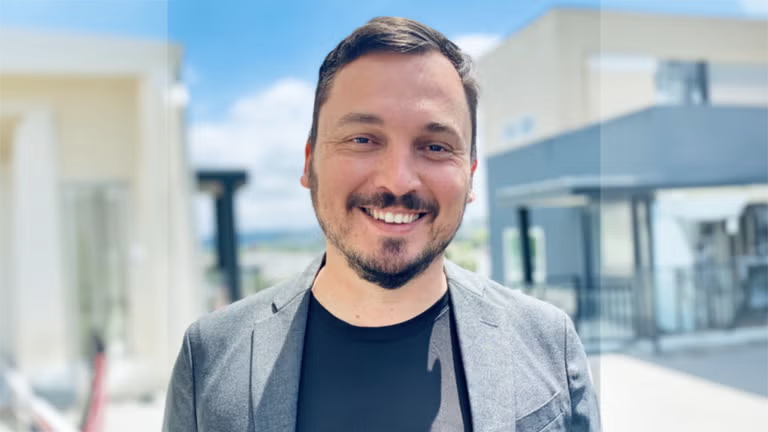
Michael Sobolev, PhD, is a behavioral scientist and technologist specializing in behavioral design and data science for health and wellness. He earned his PhD from the Faculty of Data and Decision Sciences at the Technion – Israel Institute of Technology in 2017. Over the next five years, he was a postdoctoral fellow and lecturer in Computer and Information Science at Cornell Tech and Northwell Health in New York City. In 2022, he moved to Los Angeles to establish the Behavioral Design Unit at Cedars-Sinai Medical Center, where he applies behavioral science to drive innovation in healthcare. During this time, he also served as a visiting scholar at the Schaeffer Center for Health Policy & Economics at USC. Beyond academia, Dr. Sobolev works with startups and nonprofits to design and implement consumer-facing products that improve health and well-being.
Abstract
Recent challenges in designing and implementing health technology are fundamentally sociotechnical, arising from the interplay between human, social, and technical factors. A persistent challenge in digital health is sustaining user engagement, as evidenced by high dropout rates in mobile health apps and low adherence to interventions. This talk explores the intersection of behavioral science and design for health, focusing on the role of preferences, choice, and optimization in digital interventions. Through examples from my research on weight management, alcohol reduction, and smoking cessation, I will illustrate how the field can leverage behavioral insights in conjunction with novel methodologies, such as data science techniques and personalization, to design better health technology. Maximizing the potential of health technology requires integrating behavioral science with a sociotechnical perspective to improve engagement and effectiveness. By doing so, we can develop more effective interventions that promote long-term engagement, behavior change, and health.