Food Systems Institute
The Food Systems Institute generates actionable scientific insights to help to build food systems that support human health, planetary health, and fairness.

How we make a difference
Impact
Our work intends to create food systems that:
- support food and nutrition security, healthy diets, and good health for all people
- are sustainable, so that the foods we produce and eat are good for the health of the planet
- are fair, meaning people have equal opportunities to produce, access, and eat good food
Research & Partnerships
We conduct high quality research that leads to real world impacts.
We use systems science to understand the complexity of food issues and inform food system transformation.
We do team science. Experts in public health, behavioral science, public policy, spatial science, and data science work with community stakeholders and external partners to tackle complex problems.

Projects
(PI: de la Haye)
LA County CalFresh Enrollment
CalFresh (known nationally as SNAP) is effective at alleviating food insecurity, but an estimated 300,000+ Los Angeles (LA) County residents are eligible for this program but not enrolled. We are developing rich profiles of people who are under-enrolled in CalFresh, creating science-based outreach and messaging strategies, and disseminating these to local stakeholders to increase program enrollment.
Funding: Angell Foundation

(PIs: de la Haye, Gates, Portnoy)
Food Sovereignty
This study documented data and infrastructure relevant to the food needs of Angelenos who have faced historical barriers to food access and capital, and engaged a local network of community-led organizations working across the food system.
Funding: Amalgamated Foundation

Open Access LA
Open Access LA is a free online portal designed to connect food entrepreneurs to local resources including capital, permitting, licensing, loan and credit opportunities, technical assistance, training programs, and more. These resources can help Los Angeles’ food entrepreneurs plan, launch, and grow their food truck, restaurant, cafe, private label, catering, or other food businesses.
(PI: de la Haye)
Smart & Connected Community Food Systems
This project develops a new, community-engaged approach to monitor and understand food security and community food systems, and how these are impacted by crises like COVID-19. We are building a data dashboard called Food Base LA to share this timely information with stakeholders who are addressing food challenges, like policymakers and local organizations, so they can help residents access sufficient healthy food.
Funding: National Science Foundation (Grant No. 2125616), USC Dornsife Public Exchange, American Heart Association, Keck Medicine of USC, Keck School of Medicine, USC Dornsife Emergency Fund

(PI: Lee)
Artificial Intelligence, Modeling, and Informatics for Nutrition Guidance and Systems (AIMINGS) Center
This is the artificial intelligence (AI) and data modeling center for the National Institutes of Health Nutrition for Precision Health Initiative. Precision Nutrition assumes that the best diet for one individual may look different than the best diet for another, because people have different responses to specific foods and nutrients. The AIMINGS Center uses new data science tools to develop algorithms that will predict individual responses to food and dietary patterns, in a way that accounts for the complex systems that impact nutrition, eating, and food access.
Funding: National Institutes of Health (Grant 1U54TR004279)
PIs: Horn, Moro, de la Haye
Using Big Mobility Data to Map the Food Environments of Diverse Los Angeles Residents
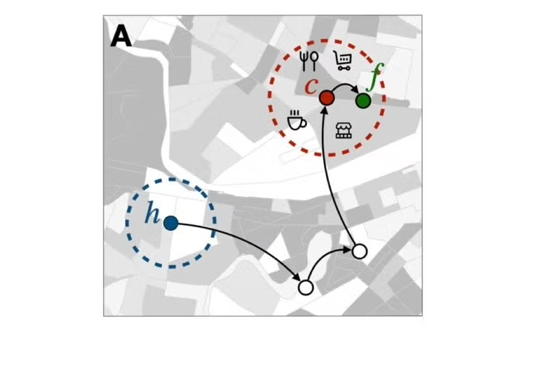
This study uses big data on human mobility—data from smartphones that capture our location—to understand how people move around urban areas to acquire food, within and beyond their home neighborhood. We use new data science and AI methods to understand how mobile food environments shape food choice, and how these insights can be used in policy and urban planning to improve healthy food access.
Funding: National Science Foundation (Grant 2427150), USC Keck School of Medicine (PI: de la Haye, Moro)

(PI: A. Horn)
Analyzing Digital Menu Data to Characterize Nutritional Quality of Food Environments
This project draws on digital menus and nutrition data, and applies language modeling and machine learning, to develop an algorithm that estimates the nutritional quality of restaurants. The goal is to develop tools that can generate more nuanced and useful information about the quality of food available within restaurants and neighborhood food environments, and differences in access to nutritious foods.
Funding: National Institute of Minority Health and Health Disparities (NIMHD) under award P50MD017344 to the Southern California Center for Latino Health.

(PI: A. Horn)
A.I.-Driven Meal Recommendations To Meet Nutritional Dietary Needs
This project is developing a mobile app that will support clinicians in implementing meal prescription interventions that are tailored to the needs of patients with different food preferences. Existing apps for meal planning tend to focus on Western diets. The algorithms we are developing will help to recommend meals that meet the multi-criteria objectives of clinical requirements, dietary restrictions, cost limits, and dietary preferences.
Funding: Keston Exploratory Research Award to the Information Sciences Institute

Healthy and Sustainable Food Labels: The Food Basket Study
This study examines how labels on food can be used to promote healthy and sustainable food choices. In a nationally representative survey, we conduct experiments where people choose between two gourmet food gift baskets: one with meat and dairy, and one without. We find that few chose the food basket without meat and dairy when it was labelled “vegan” (20%) or “plant-based” (27%), while more than 40% chose this basket when it was labeled “healthy” and/or “sustainable”.
Funding: USC Center for Economic and Social Research, USC Wrigley Institute for Environment and Sustainability, USC Schaeffer Center for Health Policy and Economics, and the National Science Foundation (Grant 2125616).
Kayla de la Haye, PhD, Director

The Food Systems Institute is founded and directed by Dr. Kayla de la Haye, a scientist at the University of Southern California’s (USC) Center for Economic and Social Research.
Her work aims to understand and promote healthy and sustainable eating, and food and nutrition security, to ultimately support good health and prevent chronic disease.
Kayla was trained in health psychology, and her areas of expertise are:
- behavioral science and interventions for health behaviors
- using social networks and systems science to address complex public health issues
- team science that engages with community and external partners to have a real world impact
Kayla grew up in the Canadian prairies, went to university in Australia, and has lived in Los Angeles for the past 15 years.
Bluesky: @kayladelahaye.bsky.social
Meet the Team


Research Affiliates
Working Across Disciplines



Strategic Partners







Impact
In the News
Tariffs expected to increase prices of healthy foods
Television, NBC Los Angeles
‘It’s super impactful.’ Eastside residents attend first-ever farmers market in City Terrace
News Article, Boyle Heights Beat
Amid fast food price hike, what are affordable alternatives in LA’s food deserts?
News Article, NBC Los Angeles
New research shows “you are what … or rather … where you eat”
USC Dornsife News
With fewer options, South L.A. braces for bigger bills at fast-food restaurants
News Article, LA Times
Environment & Public Health Crisis Intervention
Feed Your Power Podcast
State pilot program stretches CalFresh benefits amid rising food insecurity in SoCal
Television, ABC7 Eyewitness News
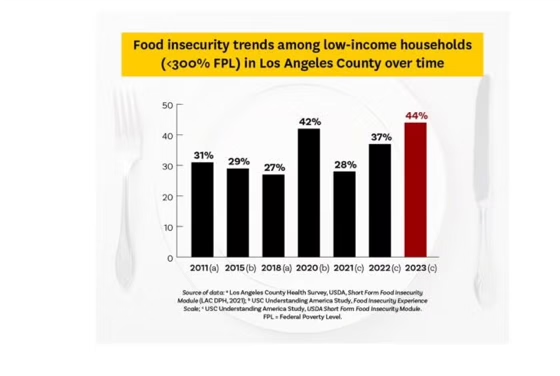
Study: 1 in 3 LA County households are food insecure
Television, NBC Los Angeles
Condado de los Ángeles: estudio revela que 1 de cada 3 hogares padece inseguridad alimentaria
Television, Telemundo
The secret to getting people to eat more plant-based food
News Article, Washington Post
Smartphone data reveals the link between fast food outlets and diet-related diseases
News Article, News Medical
Food insecurity in LA County is getting worse, not better, study finds
News Article, LAist
Let’s end hunger in Lost Angeles County
News Article, LA Times
Academic Publications
Food insecurity, dietary quality, and the role of social network support and barriers among immigrant Latino adults in New York City
J. Journal of Hunger & Environmental Nutrition
New insights into grocery store visits among east Los Angeles residents using mobility data
Health & Place
Effect of mobile food environments on fast food visits
Nature Communications
Population mobility data provides meaningful indicators of fast food intake and diet-related diseases in diverse populations
npj Digital Medicine
Food Insecurity Is Under-reported in Surveys That Ask About the Past Year
American Journal of Preventive Medicine
Emerging Applications of Machine Learning in Food Safety
Ann. Rev. of Food Science and Technology
Public perceptions of how to reduce carbon footprints of consumer food choices
Environmental Research Letters

Contact
Food Systems Institute
Center for Economic Research and Social Research (CESR)
University of Southern California
635 Downey Way, VPD, Los Angeles, CA 90089